Call (864) 501-5241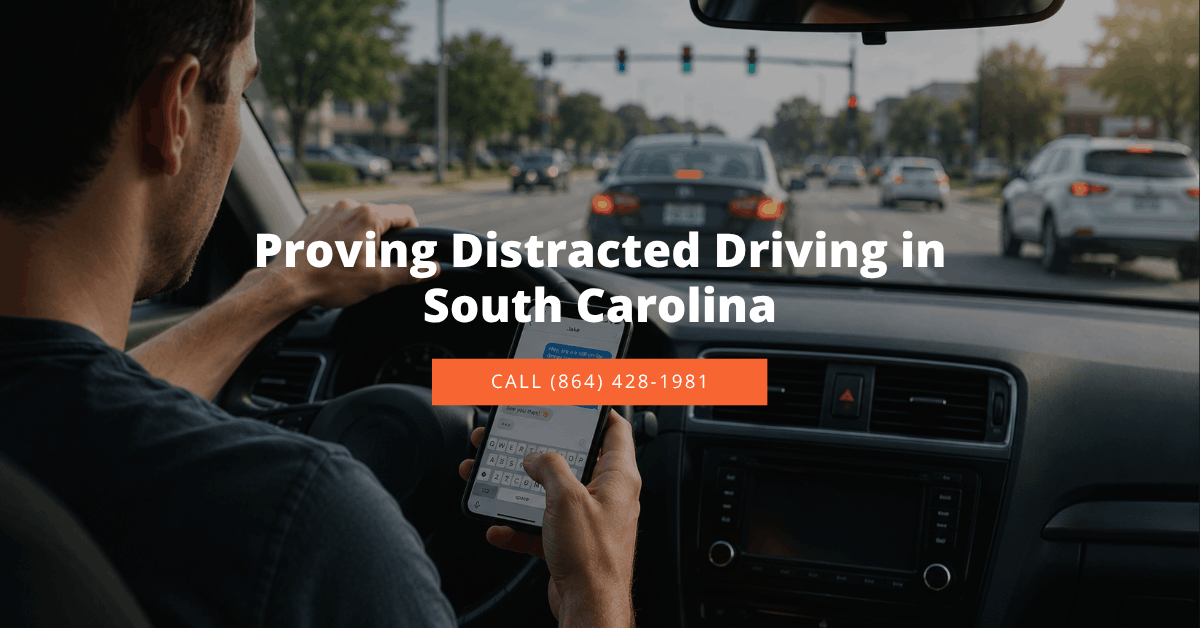
Proving Distracted Driving in South Carolina
In South Carolina, it is against the law to engage in distracted driving. This includes everything from texting to scrolling through social media to adjusting the GPS. Unfortunately, it can often be difficult to prove that a driver caused an accident because they were distracted behind the wheel.
However, it is possible to prove distracted driving with the help of a South Carolina personal injury lawyer. Evidence from smartphones, vehicle systems, witnesses, traffic cameras, accident reconstruction analysis, and the crash scene can help establish whether the driver was distracted and if that distraction caused the collision. If law enforcement issued a ticket for distracted driving, that can also be strong evidence to prove that the other driver was at fault for the accident.
At Brooks Derrick Accident and Injury Lawyers, we aggressively advocate for the rights of accident victims. This includes thoroughly investigating each case to prove that another driver was responsible for a crash. Reach out to our law firm today to schedule a free initial consultation with a Simpsonville, SC car accident lawyer.
What Counts As Distracted Driving?
Distracted driving occurs when a driver’s attention is diverted in some way from the task of safely operating a vehicle. Distractions can be:
- Visual: Taking your eyes off the road
- Manual: Taking your hands off the wheel
- Cognitive: Taking your mind off driving
A distraction can also be a combination of the three. Common examples of distracted driving include:
- Texting or reading messages
- Scrolling through social media
- Looking at a GPS or navigation app
- Holding or using a cellphone
- Adjusting music or other controls
- Eating or drinking
- Applying makeup or grooming
- Reaching for something inside of the vehicle
- Talking with passengers
- Watching videos
- Looking away from traffic for an extended period
Using a smartphone is probably the best-known and most dangerous form of distracted driving. That is because it often involves all three forms of distraction: a driver may look away from the road, take a hand off the steering wheel, and mentally focus on a conversation or message.
Under South Carolina’s Hands-Free and Distracted Driving Law, it is illegal to operate a motor vehicle on a public highway while holding or supporting a mobile electronic device with any part of the body. It also prohibits reading, composing, or transmitting text and watching motion on a mobile electronic device while operating a vehicle.
Importantly, a personal injury claim for a car accident isn’t limited to violations of the distracted driving statute. A driver can be held responsible for a crash if they were distracted at the time, even if they weren’t using a phone or other device at the time. A South Carolina car accident attorney can help you understand your rights if you were hurt in a distracted driving accident of any kind.
Why Proving Distracted Driving Can Be Difficult
The biggest challenge in a distracted driving accident case is that distraction often leaves no obvious evidence. Unlike a drunk driving accident, where the police may gather evidence of intoxication, a distracted driver may simply claim that they were looking at the road and paying attention.
For this reason, a thorough investigation is necessary. There probably won’t be a picture of a driver on their phone at the time of impact. However, attorneys can use multiple pieces of circumstantial and direct evidence to establish what the driver was doing before the crash.
For example, imagine a driver rear-ends your vehicle on I-85. The driver tells police that traffic suddenly stopped, and they couldn’t avoid the collision. However, cellphone records later show that the driver was actively texting immediately before the crash.
A nearby traffic camera shows no unusual obstruction on the road. An accident reconstruction expert also determines that the driver had sufficient time to stop. Together, those facts may provide a much stronger picture of what happened.
Evidence to Prove Distracted Driving
There may not always be direct evidence to prove that someone was distracted and that distraction caused a crash. However, several different types of evidence can often be helpful:
- Cellphone Records: One of the most important sources of evidence in suspected distracted driving cases can be phone records. Depending on the circumstances, these records may establish whether a phone was being used around the time of the collision. Relevant information can include calls, text messages, data activity, and other electronic records. However, obtaining and interpreting these records can be complicated. A cellphone record does not automatically prove that a driver was looking at the device at the precise moment of impact. A lawyer may need to combine electronic evidence with witness testimony, video, vehicle data, and an accident reconstruction analysis.
- Police Reports and Citations: Not every distracted driving accident is caused by cell phone use. However, if law enforcement tickets another driver for a violation of South Carolina’s distracted driving laws, that could be important evidence. It may also help you to establish fault more easily. Under negligence per se laws, a violation of a law can be used to presume that the other driver was responsible for the accident. Beyond distracted driving tickets, police reports can also include important information that may demonstrate distracted driving. For example, witnesses may state that the other driver was attending to crying children in the back seat or arguing with a passenger when the accident happened.
- Witness Testimony: Eyewitnesses can be particularly valuable in distracted driving cases. A person in another lane of traffic may have observed the driver holding a phone. A passenger might have noticed that the driver was changing the music immediately before the collision. Witnesses may also report that a driver drifted between lanes, failed to respond to slowing traffic, or ran a red light. This could be powerful circumstantial evidence that a driver wasn’t paying attention when the accident happened.
- Video Evidence: Video can be among the strongest evidence available because it can provide a visual record of what occurred. Potential sources of video may include:
- Traffic cameras
- Dashcams
- Business surveillance systems
- Residential security cameras
- Police vehicle cameras
- Doorbell cameras
- Recordings from other motorists
For example, a surveillance camera near an intersection might capture a driver approaching while looking down towards their phone. A dashcam video from another vehicle could show a driver drifting across a lane before striking another car. Video can also help to establish the timing of the crash and provide information that can be compared with phone records.
- Vehicle Data: Modern vehicles can provide another source of evidence. Event data recorder information and other electronic systems may contain information about speed, braking, acceleration, and other vehicle conditions surrounding a crash.
- Accident Reconstruction: Accident reconstruction experts can evaluate vehicle data, damage to the vehicles, and the crash scene to determine the cause of an accident. The expert may examine:
- Skid marks
- Vehicle damage
- Final resting positions
- Debris patterns
- Road conditions
- Vehicle speeds
- Sight distances
- Traffic patterns
This can help to reconstruct what happened in the seconds leading up to the accident.
- Social Media and Other Digital Evidence: There is often digital evidence beyond phone records that can prove a distracted driving case. In some cases, social media activity may become relevant. For example, there may be evidence that the at-fault driver posted to social media around the time of the crash. Other electronic evidence may include GPS information, connected vehicle data, app activity, or information from other devices.
A distracted driver will rarely admit that they were distracted at the time of the crash. A skilled Simpsonville car accident lawyer can gather evidence to prove your case and get you the best possible outcome.
Contact Brooks Derrick Accident and Injury Lawyers for a Free Consultation
When you are hurt in a distracted driving accident, the last thing you want to worry about is how you will prove that the other driver took their eyes or mind off the road. Our South Carolina car accident attorneys can take on the burden for you, using cell phone records, witness accounts, traffic camera footage, vehicle data, and other evidence to prove that the other driver was distracted at the time of the crash. We will then fight to get you the compensation that you deserve.
At Brooks Derrick Accident and Injury Lawyers, we work hard to help our clients get justice for their injuries. Distracted driving is both illegal and dangerous. If you were hurt in a distracted driving crash, call us at 864-531-7765 or fill out our online contact form to schedule a free consultation with a Simpsonville car accident lawyer.