Call (864) 501-5241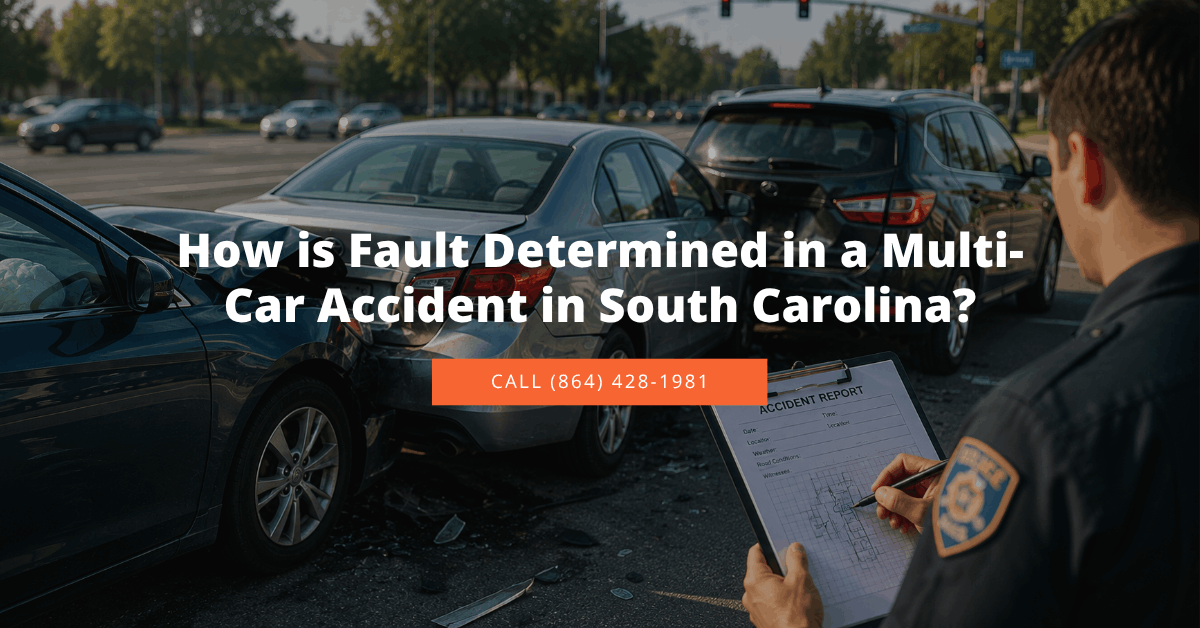
How is Fault Determined in a Multi-Car Accident in South Carolina?
A multi-car accident can turn a straightforward insurance claim into a complicated fight over who caused what. In a chain-reaction collision, one driver may rear-end another vehicle, forcing that vehicle into a third car. A fourth driver then may collide with the wreck. By the time the vehicles come to a stop, several people may have contributed to the crash and also suffered injuries.
Determining fault in these cases requires more than simply identifying the driver who made the first or last impact. Figuring out how each driver’s conduct contributed to the crash and the resulting injuries is critical to getting accident victims compensation for their injuries. Our South Carolina car accident attorneys will fight to prove that you are entitled to money for your property damage, medical bills, lost wages, pain and suffering, and other losses.
At Brooks Derrick Accident & Injury Lawyers, we thoroughly investigate each car accident claim, working with experts to establish exactly who was at fault for a crash. Our ultimate goal is to get you maximum compensation for your losses. Contact our law firm today to schedule a free initial consultation with a Simpsonville personal injury lawyer.
Why Multi-Car Accident Cases Are So Complicated
In a typical two-vehicle collision, determining liability may be relatively straightforward. For example, if one driver runs a red light and hits another vehicle, evidence such as traffic camera footage, eyewitness accounts, and vehicle damage may clearly establish what happened.
A chain-reaction accident is different. Consider a hypothetical crash on I-385. Driver A suddenly brakes in heavy traffic. Driver B is following too closely and strikes Driver A. The impact pushes Driver A’s vehicle into Driver C. Driver D then fails to stop and crashes into Driver C.
In this situation, who is responsible for Driver C’s injuries? It is possible that multiple drivers bear some responsibility for the crash, including:
- Driver B’s following distance may have contributed to the initial collision.
- Driver A could have some liability if the initial sudden braking was caused by negligent conduct.
- Driver D’s failure to stop may have caused the final impact.
In addition, weather, road conditions, vehicle defects, or another circumstance could have also contributed to the accident.
In multi-vehicle accidents, the question isn’t simply who hit whom. Instead, the investigation must determine which actions were a direct cause of the injuries and damage. This requires a careful analysis of the entire sequence of events leading up to the crash.
South Carolina’s 51% Bar to Recovery
Determining fault is important for many reasons. One of these reasons is South Carolina’s modified comparative negligence rule, which may prevent an accident victim from recovering full compensation for their injuries.
Under this rule, an injured person can recover damages if their share of fault for an accident is 50% or less. However, the amount recovered is reduced according to the person’s percentage of fault.
For example, consider a situation where a jury determines that a person injured in a multi-vehicle accident suffered $200,000 in damages but was 20% responsible for the accident. The person’s recovery would be reduced by 20%, leaving a potential recovery of $160,000.
In these cases, the critical threshold is 50%. If the injured person is found to be more than 50% at fault, they cannot recover damages under South Carolina’s comparative negligence rules. In a multi-car accident, that 51% bar to recovery can become incredibly important.
An insurance company may attempt to argue that an injured driver was partially responsible for the collision. Even a relatively small percentage of fault can reduce the value of a claim. More importantly, an allegation that the injured person was more than 50% responsible could potentially prevent recovery altogether.
That is one reason why it is so important to thoroughly investigate an accident before accepting another driver’s or insurance company’s version of events. Our Simpsonville car accident lawyers will advocate for your interests, including any claims that you were responsible for a collision.
What Changed with South Carolina Act 42?
Recently, Act 42 of 2025 took effect in South Carolina. This law made important changes to the state’s rules related to the allocation of fault. This law is particularly relevant to situations where multiple people contributed to an injury.
Under this law, the allocation of fault has become even more important. It states that in cases involving indivisible damages involving more than one responsible party, joint and several liability does not apply to a person whose conduct is found to be less than 50% of the total fault. A defendant found to be less than 50% at fault is liable only for their percentage of the indivisible damages.
For injury victims, the practical impact of this law is that the allocation of fault between multiple drivers in a car accident case is even more important. It also means that identifying every potentially responsible individual or entity is especially critical. Under this law, the allocation of fault among all relevant parties can directly affect how much compensation an injured person can recover from each responsible defendant.
How Is Fault Proven in a Multi-Vehicle Crash?
Assigning percentages of fault requires evidence. In a complicated pileup, this evidence may come from several different sources:
- Accident Reconstruction: A forensic accident reconstruction expert may analyze the physical evidence to determine how the collision occurred. Depending on the circumstances, an expert may examine:
- Vehicle positions after the collision
- Skid marks and tire marks
- Point-of-impact evidence
- Vehicle crush patterns
- Damage severity
- Debris locations
- Roadway measurements
- Vehicle weight and dimensions
- Event data recorder information
- Vehicle speeds
- Driver reaction times
- Visibility and stopping distances
The goal is to reconstruct the sequence of events as accurately as possible. In a chain-reaction accident, this can help distinguish the initial collision from subsequent impacts.
- Vehicle Damage Patterns: The damage to each vehicle can provide important clues. For example, damage to the rear of one vehicle may indicate that it was struck from behind. Damage to the front may show that it subsequently struck another vehicle. The location, direction, and severity of damage can help investigators determine the order and nature of impacts. In a serious pileup, vehicles can sustain multiple impacts from different directions. An experienced reconstruction expert may be able to determine which damage resulted from which collision.
- Electronic Evidence: Modern vehicles can contain invaluable electronic information. Event data recorders, sometimes referred to as “black boxes,” may record information about vehicle speed, braking, acceleration, seat belt use, and other factors immediately before or during a crash, depending on the vehicle and circumstances. Other potential evidence can include:
- Dashcam footage
- Surveillance video
- Cellphone records
- GPS information
- Commercial vehicle logs for truck accidents
Preserving this evidence quickly can be critical because video may be overwritten or deleted.
- Eyewitness Testimony: People who witnessed the accident may provide information about what happened before the collision. An eyewitness may have seen a driver speeding, changing lanes aggressively, following too closely, failing to brake, or driving while distracted. However, witnesses do not always see the entire sequence of a multi-car collision. Their accounts should be evaluated alongside physical and electronic evidence.
- Police Reports and Evidence from the Scene: Police officers responding to a major collision may document vehicle positions, road conditions, statements from drivers and witnesses, citations, visible damage, and other observations. A police report can often be useful evidence, but it is not necessarily the final word on civil liability. A thorough investigation may uncover information that was unavailable or unknown when officers initially arrived on the scene.
Talk to a Simpsonville, SC Personal Injury Attorney
Determining fault in a multi-vehicle accident is rarely as simple as identifying the driver who made the first impact. Determining liability may require reconstructing the crash, examining vehicle damage, reviewing electronic evidence, locating witnesses, and determining how each person’s conduct contributed to the injuries. Our law firm is adept at analyzing this evidence and working with experts to build the strongest possible case for compensation.
At Brooks Derrick Accident and Injury Lawyers, we are fierce advocates for clients who have been hurt in all types of accidents. We offer free initial consultations and never charge a fee unless we recover money for you. Give us a call at 864-531-7765 or fill out our online contact form to schedule a free consultation with a Simpsonville car accident lawyer.