Call (864) 501-5241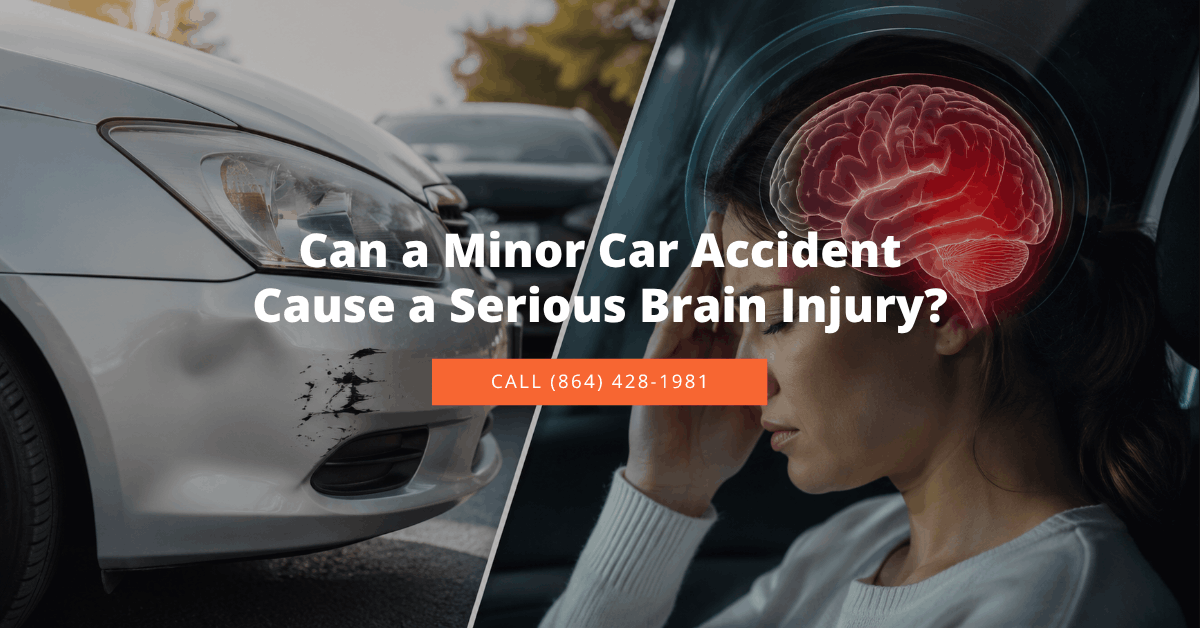
Can a Minor Car Accident Cause a Serious Brain Injury?
Many people assume that if a car accident only leaves behind a scratched bumper or a small dent, everyone involved probably walked away unharmed. Unfortunately, that assumption is not always true.
Even a seemingly minor car crash can cause injuries that affect a person for weeks, months, or even years. A concussion or traumatic brain injury (TBI) does not require a catastrophic collision. Even a low-speed impact can generate enough force to injure the brain.
At Brooks Derrick Accident and Injury Lawyers, we know how to push back against insurance companies that try to claim that accident victims can’t possibly have a brain injury because the damage to their vehicle was minimal. We are fierce advocates for our clients, working to get them maximum compensation for their injuries. Reach out to our law firm today to schedule a free initial consultation with a Simpsonville, South Carolina personal injury lawyer.
The Myth of the “Minor Fender Bender”
One of the biggest misconceptions after a car accident is that property damage tells the whole story. If you were in a relatively minor car crash, you might hear comments like:
- “The cars barely have any damage.”
- “You were only going 20 miles per hour.”
- “If the airbags didn’t deploy, you can’t be seriously hurt.”
These statements tend to oversimplify and misunderstand how car accident injuries happen.
Modern vehicles are designed to absorb crash energy. Crumple zones, reinforced frames, and advanced bumpers are intended to protect occupants, not necessarily to show dramatic visible damage.
Even if your vehicle appears relatively intact, your body still experiences the forces created during a collision. Unlike your car, your brain has no seatbelt.
Can a Low-Speed Crash Really Cause a Brain Injury?
A low-speed crash can cause a brain injury. Medical research has consistently shown that traumatic brain injuries can occur in low-speed collisions. While high-speed crashes certainly carry a greater risk of severe injuries, the speed of the vehicles alone does not determine whether a concussion or other brain injury occurs.
Several factors influence whether someone experiences a brain injury, including:
- The direction of the impact
- Sudden acceleration and deceleration
- Whether the head strikes part of the vehicle
- Seat position
- Headrest positioning
- Age
- Previous concussions
- Individual health conditions
Two people involved in the same car crash may experience completely different outcomes. The reality is that it is very possible to suffer a brain injury even if your car accident appears minor on paper.
Understanding the Biomechanics of a Traumatic Brain Injury
Many people imagine that a brain injury only happens in a car accident when someone hits their head against the steering wheel or windshield. In reality, the brain can be injured even without a direct blow to the head. It can happen in multiple ways:
During a collision, your vehicle may stop suddenly, but your body may continue to move. When this happens, your neck snaps forward and backward in a motion commonly known as whiplash. Although your skull stops moving relatively quickly, your brain continues traveling inside the skull before striking the inner surfaces. That rapid movement can stretch and damage delicate brain tissue.
One common type of traumatic brain injury is called a coup-contrecoup injury. First, the brain strikes the inside of the skull on the side closest to the impact. This is called the coup injury.
Then, because of the momentum created by the collision, the brain rebounds and strikes the opposite side of the skull. This second impact is known as the contrecoup injury.
As a result, injuries can occur in multiple areas of the brain, even when there is no visible injury to the head. This explains why someone involved in a relatively low-speed collision may experience significant neurological symptoms despite having no cuts, bruises, or fractures.
The brain is made of soft tissue suspended in cerebrospinal fluid. While that fluid provides some protection, it cannot completely prevent injury during sudden acceleration or deceleration. Even relatively small movements can:
- Stretch nerve fibers
- Disrupt communication between brain cells
- Cause microscopic bleeding
- Trigger inflammation
- Affect memory, concentration, mood, and balance
These injuries often cannot be seen with the naked eye. This makes it all the more important to seek medical treatment after even a relatively minor car accident.
Why Brain Injuries Are Often Missed After a Car Accident
Unlike broken bones or deep cuts, a concussion may not produce obvious external signs. Many accident victims leave the scene believing that they’re simply shaken up or a little sore. However, adrenaline masks pain, and shock can delay symptoms.
Hours or days later, you may start to see signs of a brain injury. Unfortunately, because they don’t have visible injuries, many people delay seeking medical attention until their symptoms become difficult to ignore. Waiting too long can often make it harder to recover physically.
It can also create challenges when it comes to filing an insurance claim. That is why it is always a good idea to get checked out after any motor vehicle accident. You can also schedule a consultation with a Simpsonville car accident lawyer to get input on a potential claim.
Delayed Symptoms of a Concussion or Mild Traumatic Brain Injury
One of the most important things to understand about concussions is that symptoms do not always appear immediately. Some develop within hours, while others may take several days to show.
If you have been in a car accident, you should pay close attention to symptoms such as:
- Persistent Headaches: Headaches that continue after a collision should never be dismissed as normal soreness.
- Memory Problems: You may notice things like:
- Forgetting conversations
- Missing appointments
- Difficulty recalling words
- Losing your train of thought
- Brain Fog: Many concussion victims describe feeling like they are thinking through a cloud. Simple tasks may suddenly require much more effort.
- Difficulty Concentrating: Reading emails, completing work assignments, or following conversations may become unexpectedly challenging.
- Mood Changes: Brain injuries often affect emotional regulation. Victims may experience:
- Irritability
- Anxiety
- Depression
- Mood swings
- Increased frustration
These changes are genuine neurological symptoms, not signs of weakness.
- Light and Noise Sensitivity: Bright lights, television screens, sunlight, or loud environments may suddenly become overwhelming.
- Sleep Disruptions: A concussion can interfere with normal sleep patterns. Some people experience:
- Insomnia
- Sleeping much more than usual
- Frequent waking
- Difficulty feeling rested
- Dizziness or Balance Problems: Feeling unsteady while walking or experiencing unexplained dizziness can signal a brain injury.
- Nausea: Persistent nausea after a collision should always be evaluated by a healthcare provider.
- Vision Problems: Symptoms may include:
- Blurry vision
- Double vision
- Difficulty focusing
- Eye strain
If any of these symptoms appear after a car accident, seek medical evaluation promptly, even if the collision seemed minor. The sooner a concussion is diagnosed, the sooner appropriate treatment can begin. Early intervention may include:
- Cognitive rest
- Physical therapy
- Vestibular therapy
- Vision therapy
- Occupational therapy
- Neurological monitoring
Ignoring symptoms can increase recovery time and make daily life significantly more difficult.
Combating the “No Property Damage = No Injury” Insurance Defense
After a car accident, insurance companies often argue that minimal vehicle damage means that significant injuries are impossible. The problem with this argument is that medical science simply does not support that conclusion.
Property damage estimates measure damage to metal, plastic, and paint. They do not measure what happened inside your body. The forces necessary to produce whiplash and mild traumatic brain injuries may occur in crashes that leave relatively little visible vehicle damage.
Insurance companies make these arguments as a way to minimize payouts. Fortunately, objective medical evidence can tell a much more accurate story than simply assuming a person must not have significant injuries based on the level of property damage to a car.
Evidence used to support a claim can include:
- Neurological Examinations: A thorough neurological evaluation can document problems involving:
- Reflexes
- Balance
- Coordination
- Cognitive function
- Eye movements
- Sensation
These findings provide evidence that goes beyond a person’s subjective complaints.
- Neurocognitive Testing: Comprehensive cognitive testing can identify deficits involving:
- Memory
- Attention
- Processing speed
- Executive functioning
- Problem-solving
- Language skills
These standardized assessments compare a patient’s performance against established norms, helping to identify impairments that may not be obvious during a routine office visit.
- Advanced Imaging: While standard CT scans and MRIs are essential for identifying serious structural injuries, they do not always detect mild traumatic brain injuries. Depending on a patient’s symptoms, specialists may recommend additional diagnostic tools or advanced imaging techniques to better evaluate brain function or rule out other conditions. Your treating physicians, not the insurance company, are in the best position to determine what testing is medically appropriate.
- Ongoing Medical Documentation: Consistent medical treatment creates a clear timeline showing:
- When symptoms began
- How symptoms changed over time
- What treatments were necessary
- How the injury affected daily activities
This documentation often becomes critical evidence if the insurance company disputes the seriousness of your injury.
If you are experiencing symptoms of a concussion or traumatic brain injury after a car crash, there is help. Our experienced team of Simpsonville car accident attorneys will listen to your story, advise you of your rights, and start gathering evidence to prove your claim. We’ll take on the big insurance company for you, fighting back against any suggestion that you couldn’t possibly have a serious injury because property damage was minimal.
How Derrick Law Office Can Help
When insurance companies point to minimal property damage as evidence that you couldn’t have been seriously injured, it’s easy to feel frustrated or dismissed. But your symptoms deserve to be taken seriously. Building a successful brain injury claim requires more than photos of damaged vehicles; it requires medical records, expert evaluations, neurological testing, and a clear understanding of how traumatic brain injuries occur.
At Brooks Derrick Accident and Injury Lawyers, we understand that the effects of a concussion or traumatic brain injury are often invisible, but they can profoundly affect every aspect of your life. We work with medical experts and carefully evaluate evidence to help clients pursue compensation that reflects the true impact of their injuries. Give us a call at 864-531-7765 or fill out our online contact form to schedule a free consultation with a Simpsonville car accident lawyer.